Generative AI on Alibaba Cloud
A chapter-by-chapter series that applies Generative AI on AWS to Alibaba Cloud Model Studio, PAI and Qwen, with runnable demos and token cost for each step.
Each guide includes a runnable demo against Model Studio in the Singapore region, the requests it sends, and the documentation checked on the publish date.
Guide details
- Platform
- Alibaba Cloud Model Studio and PAI
- Models
- Qwen3.8 and Qwen3.7 hosted models
- Example region
- Singapore, ap-southeast-1
- Source book
- Generative AI on AWS, O'Reilly, 2023
- Last technically verified
- October 8, 2026
- Documentation baseline
- Alibaba Cloud documentation available on October 8, 2026
What you will build
-
A priced model choice
Monthly token cost for four Qwen models on one workload, before any code ships.
-
A scoped first call
A Singapore API key limited to one model and one IP address, with Free Quota Only on.
-
A prompt test set
Zero-shot, few-shot, thinking and JSON experiments you can rerun on every prompt change.
-
A token budget per language
Measured token counts for the same instruction in five languages.
Follow the guides in order. Part 1 sets up the account, key and environment that parts 2 and 3 reuse.
-
Part 1
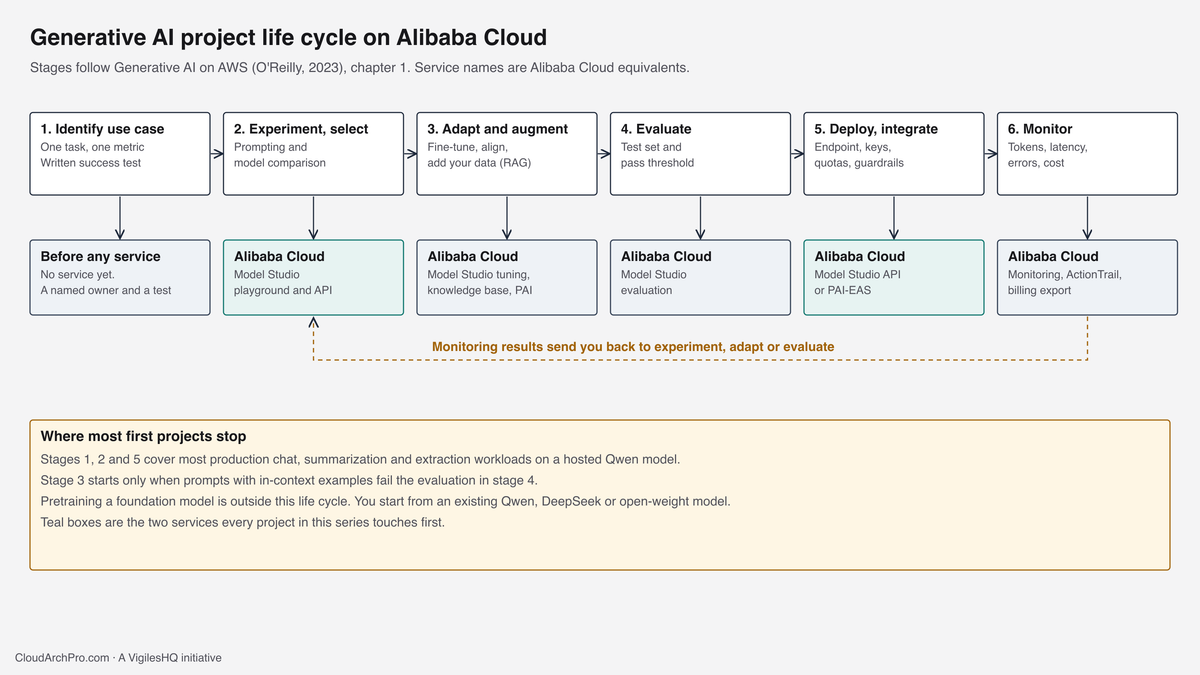
Generative AI on Alibaba Cloud: use cases, Qwen models and the project life cycle
Map chapter 1 of the book to Model Studio, PAI and monitoring. Price four Qwen models for one workload and make a first API call from Singapore with cost controls in place.
You will finish with a scoped API key, a priced first call and a model shortlist for your use case.
-
Part 2
Prompt engineering with Qwen on Alibaba Cloud Model Studio
Run zero-shot, few-shot, wrong-label, sampling, thinking and JSON experiments against qwen3.8-flash, and see what each prompt choice costs per month.
You will finish with a prompt lab you can turn into a regression test for every prompt change.
-
Part 3
How Qwen models work: tokens, embeddings, attention and scaling laws
Measure the Qwen tokenizer in five languages, size text-embedding-v4 vectors for a search index, and see how attention, context windows and mixture-of-experts show up on a Model Studio bill.
You will finish with a token budget per language and an embedding dimension tested on your own data.